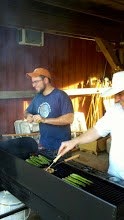
Since today is my birthday, I thought I'd share with you, the gentle reader, some art produced by others as well as the year of their birth who share this auspicious day as their natal day.
1524 Pierre de Ronsard
Je te salue...
Je te salue, ô vermeillette fente
Qui vivement entre ces flancs reluis;
Je te salue, ô bienheuré pertuis,
Qui rend ma vie heureusement contente !
C'est toi qui fais que plus ne me tourmente
L'archer volant qui causait mes ennuis;
T'ayant tenu seulement quatre nuits,
Je sens ma force en moi déjà plus lente.
ô petit trou, trou mignard, trou velu,
D'un poil follet mollement crêpelu,
Qui à ton gré domptes les plus rebelles:
Tous verts galants devraient, pour t'honnorer,
à beaux genoux te venir adorer,
Tenant au poing leurs flambantes chandelles!
1862 O. Henry
O Henry - Biography and Works
1885 D. H. Lawrence
Lady Chatterley's Lover
1903 Theodor Adorno
Frankfurt School: The Theodor Adorno Internet Archive
1935 Arvo Pärt
The Arvo Part Mp3 Page
Showing posts with label music. Show all posts
Showing posts with label music. Show all posts
9.11.2007


8.29.2007
Valse de Balfa
Another song that's been haunting me recently is Valse de Balfa, another song written by the Balfa Brothers. I was first struck by its plaintive power while listening to the Red Stick Ramblers' version from their eponymous debut. Their version, which unfortunately is not available online for listening, is driven by big propulsive drums. In contrast, the Balfa Brothers version from The Balfa Brothers Play Traditional Cajun Music lacks drums, not uncommon at the time, but carries that droning fiddle lines and more of an urgency in the vocals.
Here are the lyrics in French and the translation, again by Ann Savoy. Most poignant is verse 2, a common experience for most of us, I think.
Valse de Balfa (Balfa Waltz)
1. Quand j´ai parti de la maison
J´avais fait mon idée
J´étais parti pour te chercher, cher,
Où mourir au bout de mon sang.
When I left the house
I had made up my mind
I left to go find you, dear,
Or to end my own life.
2. Quand j´ai arrivé à ta maison
J´en ai trouvé -z-un autre avec toi
Ça, ça a cassé mon cœur, cher,
J´aimerais mieux mourir que voir ça.
2. When I got to your house
I found you with another.
that broke my heart.
I would rather die than see that.
3. Si j´aurais cinq jours dans ma vie
J´en donnerais trois dans les cinq
Pour passer las deux autres avec toi
J´aimerais mourir dans tes bras.
3. If I had five days in my life
I’d give three of the five
To stay the other two with you
I would like to die in your arms.
I had never seen the idiomatic phrase Où mourir au bout de mon sang but the construction with the verb mortir + au bout de mon sang is pretty well attested in Standard French, although I am sans my good French dictionary.
Another Cajun classic that goes a long way in explaining certain Cajun attitudes.
8.28.2007
Port Arthur Blues
Since I haven't been able to resolve some of the vocabulary issues of Valse de Port Arthur, I thought I'd give the lyrics and translation of another Cajun song about Port Arthur, Port Arthur Blues. This one was written originally by the Balfa Brothers, and it's short but poignant. Transcription and translation is courtesy of Ann Allen Savoy from her wonderful book, Cajun Music: A Reflection of the People, Vol. I.
1. Tu m'as dit hier au soir / tu pouvais plus rev'nir
plus t'en revenir pour me rejoindre à la maison
ô ya-yaïe!
1. You told me last night
You couldn't love me anymore
You couldn't come back to meet me
At the house anymore, oh it hurts!
2. Mon, je vois pas / Qui je t'ai fait
Quo' faire donc, tu veux pas / T'en revenir au Port Arthur?
ô ya-yaïe!
2. Me, I don't see what I did
So why don't you want to anymore
Come home to Port Arthur?
Oh, it hurts!
Not much to comment on, 'cept that quo' faire is Cajun French for 'Why?'. I do believe the translation of the first verse is a bit off since it looks like it should read:
You told me last night
You couldn't come back
You couldn't come back to meet me
At the house anymore, oh ya-yaïe!
8.26.2007
Valse de Port Arthur, Part I
Since my last entry ended up being about Port Arthur, I present to you one of the Cajun songs about Port Arthur. It is a waltz called Valse de Port Arthur:
1. Oh, bébé, moi j'm'en vais au Port Arthur,
Oui, 'tit' fill', c'est toi la seul' qu'moi j'aimerai,
Oh, 'tit' fill', tu es si loin de moi,
J'reviendrai pour te r'joindr' au Port Arthur.
2. Eh, 'tit' fill', t'as trouvé qu' tu m'aimais plus,
Ouais, 'tit' mom', aujourd'hui tu veux plus m'voir,
Oh, ya-yaïe, ça fait d'la pein' de te voir,
Ouais, tout l'temps j'vais m'en aller au Port Arthur.
*Transcription of the lyrics is courtesy of http://membres.lycos.fr/breric/cajun.htm.
As you can see, there is quite a bit of slurring which utterly defeats my French transcription skills so I must rely on the kindness of les étrangers. I won't offer a translation now, but I will comment on a few peculiarly Cajun French lexical items.
'tit' fill' = 'tit' is a common abbreviation for petite, sometimes shortened all the way just to 't', especially in nicknames. My cousin Anthony was referred to by my grandfather as 'T-Ton'. Somewhat obscurely, my other cousin (and we ran long on cousins, thank you) Robert was termed 'Boscoe'. This is a long-winded way of saying that 'tit' fill' is 'little girl', a term of endearment.
ya-yaïe = "oh it hurts", a very common exclamation of pain in Cajun music. Sometimes spelled yé yaille. Cajun French transcription can be non-standardized.
'tit' mom' = I suspect that this might be le môme which is a derogatory term meaning 'lad, kid'. I'll have to check and discuss it further in Part II.
8.13.2007
Grand Tasso
It's rare, but it does happen on occasion that a song affects me deeply. Last night I was listening to the Red Stick Ramblers, one of those young and upcoming bands that is preserving Cajun music, and I was dumbstruck by the song Grand Tasso. You can listen to it for free here, it's under their 2002 album "The Red Stick Ramblers." I can't stop listening to it.
Apparently it's a traditional song with additional lyrics by two of the band members, and I'm frantic that I can't find the lyrics to the song anywhere since I'd love to learn it. My French isn't good enough to decipher it, and although I can make out some of the lyrics (mixed with some English), I imagine the dialectical differences would defeat me.
In Cajun country, there is a food called tasso--a highly spiced and dried pork sausage that is an essential ingredient in gumbo and other gastronomical delights. There is a community called Tasso, by Bayou Mallet, near Eunice, deep in an area of road houses where Cajuns come to dance at the fais do do's each Saturday. The place figures in many a traditional song.
Well, there you go! The Red Stick Ramblers not only play traditional Cajun music, but they incorporate Western swing and jazz influences from folks like Bob Wills and Django Reinhardt, and they cover some of their songs as well.
Great stuff. I know Michael Doucet also recorded Grand Tasso, but the droning fiddle of the Red Stick Rambler's version gives it a touch of melancholy that fits so perfectly and the vocalist has that touch of world-weariness that carries it home. Anyone who covers That's What I Like About The South has got my admiration.
7.24.2007
Bhangra, Sitar, and Tabla at the Stern Grove on a Sunday
What a disappointment. I've liked Karsh Kale since his first album, Realize, and I suspected that I was not going to enjoy the concert yesterday at Stern Grove after previewing some of the music online and sadly, I was proven correct.
I suppose there are several factors to account for this:
1) Somewhere in the past two years, I've gotten burnt out on Asian Underground, Asian Massive, Ethnotechno (my favorite generic tag since it's more... generic and allows for music from Africa, especially North Africa) or whatever you want to call it. I used to love this stuff, but now most of it sounds... bland.
2) The Karsh Kale/Anoushka Shankar 'Breathing Under Water' project, which played yesterday, has impeccable credentials, but sadly, the whole is less than the sum of its parts. I'd expect that Karsh, Anoushka, and members from MIDIval Punditz would add up to something grand, but it was the aural equivalent of slightly pleasant and vaguely ethnic wallpaper from Pier 1. Perhaps I just don't get the 'rich orchestral textures' that seems to be an increasing part of this genre by Indian musicians. I know it's from Bollywood film music, but it makes it sound... syrupy. I thought that this element really weakened the last Badmarsh & Shri album, Signs.
3) The mix was horrible. There was no balance. In fact, given the intimacy of sitar and tabla, perhaps a smaller venue would have provided the intimacy to set the proper mood for appreciation of the music, but I doubt that it would've help.
4) Finally, arriving at 1:30 assured that I was perched precariously and uncomfortably on the hillside just to get a glimpse of the performers on stage. I have no idea why that they have put in tables in the main Stern Grove area. It seems to be a terrible waste of space and only allows a certain amount of people to actually be able to see the concert. And the number of folks in attendance yesterday far outnumbered that small space. Would felling trees actually be a bad iea in this instance to landscape the side of the hill into, I don't know, a proper amphitheater?
Subscribe to:
Posts (Atom)